Wednesday, June 17, 2015

Hello, Old Friend

Black Dog
"Hello, there, old friend. You've come to visit. How long will you be around? I hope you are not in a really bad mood. Oh...listen to me. It's all about mood, isn't it? Look. I know I can't make you totally go away. In fact, I have kind of come to enjoy your visits, which may be a real problem, but you'll have to stay out of my way. You can sit there, walk around if you want, or leave, but I won't let you destroy me. I know that is not your intention, but it's your nature. You take away my energy, and can take my hope and faith if I let you. It's just because you are all about you. You are a jealous, envious friend who does not like to see me happy with anyone or anything else. You want me to simply lie in bed, or cower in the floor with you, have a cry, or wish I could just disappear...with you. I cannot let you do that to me. You nearly destroyed me once with your obsessive, relentless nuzzling, putting your head on my lap and demanding all my attention.
You've cost me family, friends, wealth, many of my dreams, and much, much time out of my life. You made me a laughing stock at times, and an object of pity at others. People have told me you don't exist...to just walk away from you and you'll disappear forever, like an imaginary friend. I know you are real, I know where you came from, and I know you will be hiding in the shadows of my life for all my life. But in the shadows you must stay. I have things to do, and you will not stop me anymore. There are people I love, and you will not punish them anymore because of your relationship with me.
I know your little trick, too, of coming out of the shadows and acting like a normal, playful, energetic friend. It never lasts, and when I allow myself to spend time with the playful side of you, I sometimes get myself into trouble...make bad decisions. I may spend too much money on you, or throw away things I really should keep just because you get me in a good mood and I feel like nothing can go wrong...but things often do go wrong, because I'm not thinking clearly. So stay for as long as you must, but know that you are not in total control of me, because I understand you. Just be as quiet as you possibly can, and do not show your ugly side around my friends! No go lay down.
Good dog!"

Saturday, June 6, 2015

Cooking: Time, Temperature, Method, and Seasoning

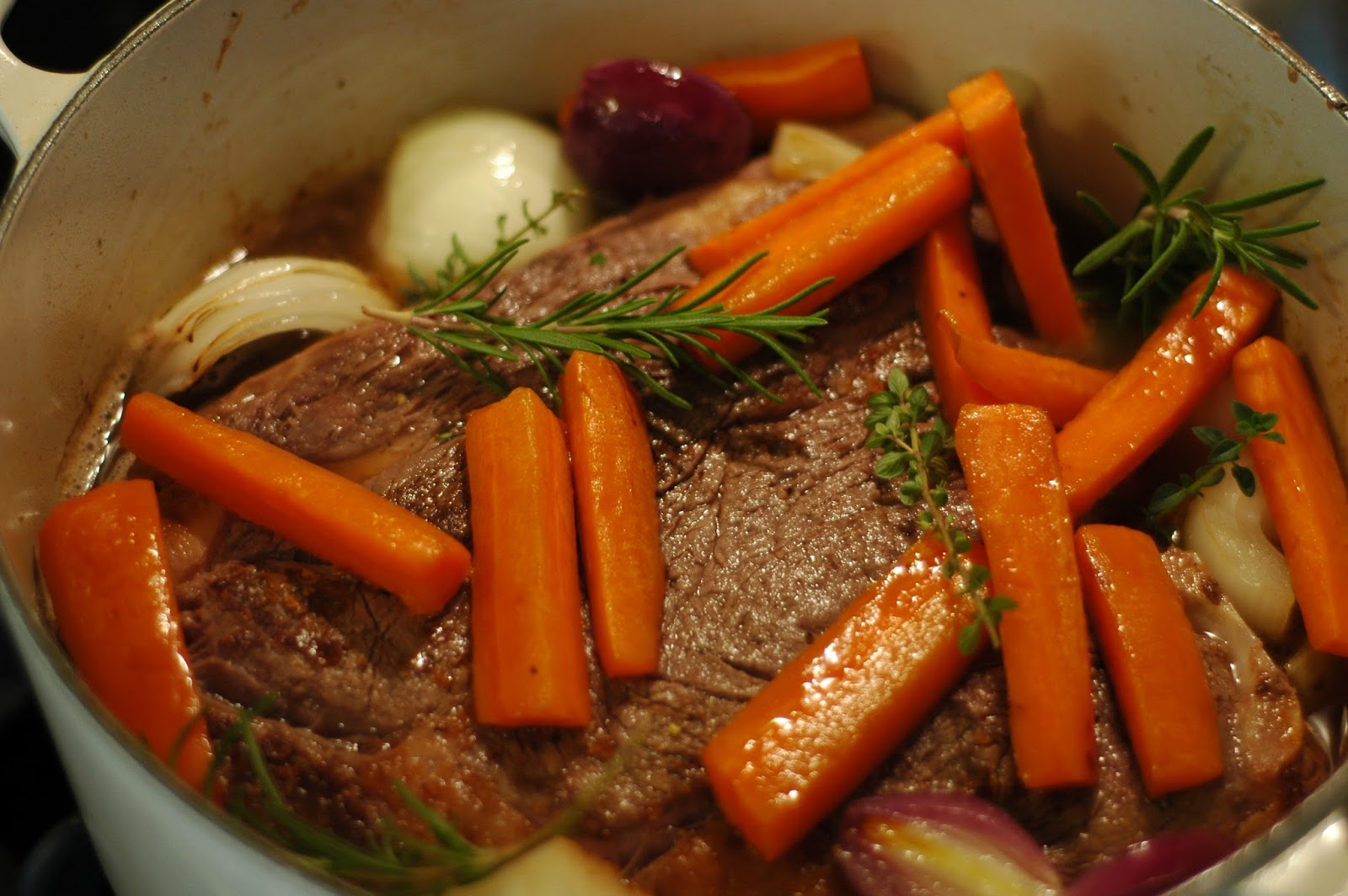
Potroast photo borrowed from http://butimhungry.com
Culinary Corner:
In cooking, nothing affects basic flavor of foods like time and temperature. High heat, low heat, quickly searing or slow cooking makes so much difference in flavor and texture of most foods. All foods are not the same when it comes to how they are best prepared. A choice ribeye steak, for instance, is amazing when flame-broiled over high heat, quickly searing the outside and sealing in juices. The inside can be anywhere from rare to well-done (yuck) depending on preference. On the other hand, a thick chuck roast or brisket is just made for slow cooking in liquid, with lower temperatures and several hours of cook time. It's how a tough meat becomes melt-in-your-mouth tender and flavorful. For slow cooking, meats taste better if browned on all sides first. I use olive oil in a medium-high skillet for this.
Microwave: Some foods are actually even better cooked in a microwave, believe it or not! Did you know that fish, such as salmon, perch, cod and other fresh or thawed fish fillets, covered and steam-cooked in the microwave oven, come out perfectly moist and tender? There's no dried out top from broiling, no fat from frying. I make poached and scrambled eggs in the microwave, too.
Grilling: Summertime means the grills come out! Some people, like me, occasionally grill all year long, but summer and grilling are soul mates.Don't confine your outdoor cooking to meats. Corn on the cob, potatoes, onions, bell peppers, tomato wedges and even big Portobello mushrooms are great from the grill, too! A grilling basket is one of my favorite ways to cook the veggies. Kabobs are great, too.
Seasoning: My rule of thumb with herbs, spices and seasonings of all kinds is - if the first thing I notice about the flavor is the seasoning, there's too much. I like to be taken by the aroma and flavor of the food I'm eating, lightly enhanced by the seasoning. I want my meats to taste like the meats they are, and the vegetables to taste like what they are, with a hint of added herbs, spices, salt, etc. I don't want to say, "Oh! That's great Italian (Mexican, etc.) seasoning! What's in it?"

Monday, May 25, 2015

Crab Bucket Syndrome

Something just became clear to me that I hadn't thought about in many years. I just heard the phrase, "crab bucket syndrome". I had never heard it before, at least to my recollection, but it describes a mentality of keeping everyone down to the level of a community or group. If someone tries to excel or better themselves, others in their community try to hold them back because of envy or jealousy.
The phrase comes from the way crabs actually act in a bucket or basket. When I was a child, my family occasionally visited North Carolina, where my mother was raised. Her mother, two brothers, and a sister resided in that state. On one particular trip we visited my uncle Johnny, who was an avid fisherman and hunter. His freezer was always full of wild game, fish, and seafood that he had caught or killed himself. On this trip, we went with him to the inland waterways of NC, got in his rowboat, and went out to the oyster bars and areas where crabs were plentiful. There are laws against harvesting these crustaceans in many locations now, but back then it was common practice for the locals. We had a couple of bushel baskets in the boat. One was for the oysters, and one for the crabs we would catch. It was fairly easy to catch the crabs. We would simply lower a line into the water where they lived that had something attached to it that the crabs could latch onto. It didn't really matter what that object was, as long as it would sink. A crab or two would grab onto the object, and we could pull it up to near the surface, where the crabs would drop off, but before they let go, we scooped them out of the water with a kind of net. Then my uncle or dad would carefully dislodge the crabs from the net and place them into the basket.
I remember asking, "Can't they climb out?"
My dad chuckled a little and said, "They'll keep each other in there."
I watched in fascination as one crab would begin to crawl up the side and two or three others would grab it and pull it back down.
Now I understand what my dad said, and where the phrase comes from - crab bucket syndrome.
After returning to my uncle's house, huge pots of water were placed on the stove to boil. The crabs were lowered into one pot, and the oysters were placed in a steamer basket in the other. I learned to love shellfish, which I still enjoy, but infrequently these days.

Thursday, November 27, 2014

Answers to Life's Persistent Questions

I have a couple of theories about human behavior that I posed to a friend the other day, to answer a couple of perplexing questions.
1. Why do we keep doing the same things over and over, and expect different results? (Einstein's definition of insanity)
Not to suppose I'm brighter than Albert Einstein, but my theory is that it's not insanity. I think it's a phenomenon that happens when we are babies. We cry. We get what we want. We cry again, and get what we want. Later on, we cry, and we don't get what we want...but we continue to cry, and cry, and cry, expecting to get what we want. The idea is that "It worked before, so it's got to work again if I keep at it." I think we keep doing the same things expecting different results because at some time in the past and in some situation, it worked...and we just can't let go of the idea that the same thing can work again. We just have to keep trying, maybe changing some little aspect, or "doing it better next time."
2. Why don't diets work? Why do we keep looking for the perfect way to lose weight and get into good physical condition, yet keep failing?
Many hundreds of ads, articles, and books are written each year about how to lose weight and get into shape. Many hundreds of drugs, supplements, fitness machines, gym memberships, etc. are sold every year in a multi-billion dollar industry. But our problems remain. My theory is that we all know how to lose weight and/or get physically fit. We all know it well, up and down, inside and out, front and back. It's simple. To lose weight, take in less calories than you burn, or conversely, burn more calories than you take in. To get into good physical condition, the answer is equally simple. The calories we do eat need to be from wise choices, and we need to exercise. That's it!
Now, to answer the question: We don't lose weight and get into shape, and diets don't work because we're simply not ready to commit. As soon as we're ready to do it, we'll do it. If we don't decide it's a priority, we'll stay fat and out of shape. End of story.
So the answer to both of these questions really goes back to making a decision and sticking to it. When we decide that what we're doing isn't working, and choose a different path...one we already know is the right solution, our lives will improve. No book, no diet, no fancy equipment, no drugs, or anything else we can by will replace simply making wise choices and deciding to live by them. We may need some help and support, and that's okay. Go out and buy that book, or supplement, or gym membership if it really will help you...but you first have to commit to a specific goal and make it a priority or none of it will help.
After note: "We keep looking for complex solutions to simple problems because we really haven't decided to solve the problem."

Saturday, October 25, 2014

Appalachian DJ and Appalachia in General

I've been a DJ for my son's company for several years now. We're in West Virginia, the only state to be completely within the bounds of the Appalachian Mountains. That's pronounced with the "ach" said with a short "a" as in the word "at", not long as in the word "ate". I like to think of it as putting an apple to your chin, and saying "apple at chin". But I digress.
Being a DJ in Appalachia is interesting, to say the least. Especially here in WV, we can range from party animal to sleepy kittens. I've played music for weddings where the couple wanted Country music, and others where the latest Hip-Hop and Pop were the order of the day. Still others wanted Classic Rock or Alternative Rock. Regardless what the original request, though "Cupid Shuffle" and "Electric Slide" are always requested, along with the number one song request of all time, "Play something I can dance to!" I think I'll write a song and name it that...and play it when they request it.
I do karaoke, too! Karaoke singers can be very good...or not. The selections they come up with are surprising sometimes, too. One Bride, in her beautiful white wedding gown, requested to sing Iron Maiden's "The Trooper". Quite often someone will request a karaoke song and stand there without a clue how to sing it. They just wanted to hear the song, so they stand there with the mic in hand. Fortunately, my karaoke tunes come with lead vocals I can punch in under those circumstances.
A wedding reception without alcohol, and a wedding reception with alcahol are two completely different affairs. That's all I'll say about that, since most of you are probably well aware of that fact.
"Getting there is half the fun," they say. In the case of many of the places I've worked, getting there can be at least half the day! Today I was DJ and Emcee at a wedding in Grantsville, WV. There is no easy way to get to Grantsville. Winding, two-lane roads are your choices no matter from which direction you approach it. The town is in a beautiful spot, though. West Virginia is nothing if not scenic.
Speaking of country roads in Appalachia, we have signs that tell us where the curves are. They are especially useful at night. For those of you not familiar with our roads, they are not straight. If you see a big, yellow sign ahead with an arrow pointing straight to the right or left, be ready...it's a curve. And it's a big curve! Slow down and be ready to turn in the direction of the arrow. There are also some smaller yellow signs with arrows. Some of them have a curved arrow, starting out straight ahead, then the curve in the line. That means the curve is up a bit ahead of you, but not far. That's followed by the big arrow pointing right or left. Now, if you see an arrow that looks like a snake, bending back and forth, it's a really curvy road ahead. If you see it in time, slow down. There's usually a number under it telling you what speed is safe traverse the area. If you don't see it in time, and you enter the area too fast, just jerk your steering wheel back and forth hard like the sign showed you...try to remember whether it went into a right turn or left turn first. Then hope you get the timing right. There is another way. you can keep going straight ahead if no cars are coming the other way. The road just turns right and left under you. That can actually work pretty well if you can see far enough ahead in the curves. It's called "straightening" the road.
Usually, the number under the arrow sign is a little slower than you really have to go. If it says 30 mph, you can probably take the curve at about 40, if you're a good driver. But if you see a sign that looks like a horseshoe and it has a number 10 under it, take it seriously! That's a KYA curve, or kiss your...aft section. People have been known to see themselves in their rear view mirror going the other way in those curves. But really, if it says 10 mph in one of that kind of curves, maybe 5 mph would be better.
I heard a story once of a bunch of kids who took one of the straight arrow signs down and put it up facing the other way. The curve went left, but the sign pointed to the right. Fortunately, they weren't so evil that they sent traffic over an embankment to their deaths, or into a stone wall. Those who went off the road ended up in a farmer's field. Now, in most places, police would be called, an investigation would ensue, and arrests would be made. In many parts of rural Appalachia, the drivers would get out, see another car they recognized and say, "Hey, Fred! How's it going? The kids got you, too, huh?"
Fred would answer, "Yup." Then the two would talk for an hour or so. If more than two or three ended up in the field, someone would start a fire and they'd make a party of it...perhaps with some moonshine from a trunk in the crowd. Either way, they'd discuss cars, sports, hunting, fishing, and their better halves, and how much trouble they were going to be in when they did go home. The owner of the field would probably come out and join them. At some point they'd probably fix the sign. Getting too crowded in the field.
Anyway, the wedding reception went well. The bride and groom rode away on the back of a fire truck, siren and lights going, and everyone waving. I made it home okay, too. Took all the curves just fine and hit the Interstate where I heard the bap bap bap of the poorly constructed highway all the way home.

Saturday, September 27, 2014

Your Perception Is Your Reality

How, and to what degree is our perception of reality skewed? Is the world, our country, our state, our city, or even our community exactly what we think it is? Are our personal relationships based on reality, fantasy, a mixture?

Okay. The title of this post is actually a statement that I generally dislike. In my view, reality is reality. It either is, or it is not. Perception does not change what is real. That being said, perception seems very much like reality. We act and react based on our perception of what is real, not always on what is actually real. For instance, if I convinced you beyond a shadow of a doubt in your mind that a ferocious animal was right outside your front door trying to get in to kill you, and you believed it with all your heart, you would act and react as if it were true, when in fact there is nothing there at all.
the reality: nothing harmful outside your door
your perception: something extremely harmful outside your door

So we act and react based on our perception of reality. To us, whatever we perceive as real is all that matters. I say that to make a point, of course. Our perception of reality is easily skewed. Marketing firms owe their huge successes that fact. Many politicians owe their positions in public office to that fact. Anyone who wants something from you, and is generally skilled in manipulative tactics is likely able to skew your perception of reality, at least to some degree. Conspiracy theorists prey on people who are most susceptible to those kinds of manipulative skills. I propose that I could take any ordinary person off the street, and with a little coaching, take that person into a medium to large city, and within a single day convince a dozen people that this ordinary fellow was the reincarnation of Abraham Lincoln. It would not be hard to find a dozen people who were gullible enough, and weak minded enough, to believe it. That is an extreme example, but all of us can be deceived. It's just a matter of to what degree, what tactics must be used, and how long it would take.

Now let's get to the main point. How, and to what degree are we deceived? Is our perception of reality, in fact, reality? Here's an example I like to use. Driving on the Interstate for a few miles, I have someone almost rear end me because they are going way over the speed limit and aren't paying attention. Maybe they are trying to text or something equally as unwise. A few seconds later, someone puts on their brakes in front of me for no apparent reason, and I almost rear end them. Just after that, a kid on a motorcycle flies by at about ninety miles per hour and cuts in front of me. Then a semi driver nearly shoves me off the road trying to get into my lane without looking. As I finally get to my exit, I'm thinking, "Everyone on the Interstate is crazy today!" Now, if I could rewind the situation, and see it in a different way, I'd notice that out of the dozens and dozens of cars moving along with me and coming the other way on the other side of the freeway, only a few of them were driven by people who were doing something ridiculous. All the rest were just driving along safely and carefully, minding their own business, not tailgating, not weaving in and out of traffic, and not causing any problems. My perception of reality would be different. "Some people on the Interstate are crazy today, but most are not," I might think.

A friend often talks about how the world has changed. People are different from what they used to be in his perception of reality. To some degree he is correct. But someone who spends very little time outside his workplace or home, and only sees what's on TV or posted on the Internet - someone who doesn't travel to any other states or cities is going to have a skewed perception of the reality of the world. TV shows, movies, the news, and all forms of media show extremes. Normal doesn't get ratings nor bring in revenue. So a person can be convinced that things are much worse, much more widespread and extreme than they really are. Then along comes someone with a web site or a radio program who tells him that things are really much worse than he even knows! There are secret conspiracies behind everything we see and hear! Our doctors can't be trusted because they would rather see millions die than expose a known cure for cancer, because it would ruin their careers!

See what I mean? False perceptions.

I am not trying to convince anyone that the world is good, nor that nothing is wrong, all is well, go back to bed. Also, most of what I am saying applies to the United States of America, still one of the best places in the world to live. My thoughts do not apply to the Middle East right now, for instance. I am merely saying let's not focus on the bad, but look for the good that is left. It's not all bad! I have been to cities from the East Coast to the West in America, and from within a few miles of the Canadian border to Houston Texas, and have seen thousands of people just being...normal. Most of them are fairly friendly, have no ulterior motive in saying "Hi," and even will hold a door for you at a store. The world is not a perfect place, and yes...it will get worse before Jesus comes back. But all is not lost just yet, and there is plenty of good that can be done. If we perceive that there is no use trying...that will become reality. Live. Laugh. Love. Pray. It's still a good life, if we choose to perceive it that way.
***

Saturday, March 22, 2014

Why Are Women So Complicated?

Women will tell you that they are complicated. Men will also tell you that women are complicated, which frustrates and annoys them most of the time. Below are some points from a recent article I read on the subject, written by a woman who did not sign her name, or I would gladly give her credit. Also mixed in are some thoughts from my own experience and from talking to women.
Before I go any further, let me say I love women, and this blog is in no way intended to offend anyone, female or male.
Now to get to it. First of all, men and women are different. No surprise there. Right? But in what ways, other than the obvious physical differences, are we so different? Our minds are different in several ways. Certain areas of a woman's brain is more dense, while other areas of a man's brain are more dense than women's. Okay, I hear you ladies. You're all saying, "We know men are dense!" But for now, let's dispense with the stereotypical put-downs, okay?
So...a woman's brain is wired and organized to better handle multitasking and instinct, where a man's brain is wired more toward performing specific tasks. In other words, guys, "We git 'er done!" Men focus on the task at hand until it's accomplished, and get annoyed if we are distracted or asked to split our attention.
Wife: "Honey, would you watch the bread in the oven, listen for the phone and give the casserole dish back to Linda next door when she comes to get it? I'll be back as soon as I pick Judy up from cheerleading practice.
Husband (muttering under his breath): "I'm never going to get this lawnmower cleaned up and ready for Spring if she keeps adding things to me! I don't have time for all that stuff!"
The fact is, she does "all that stuff" all the time, every day and doesn't think much of it, with the exception of a few times she feels overwhelmed. When that happens, she usually blows up at the guy about not helping out enough, takes a headache pill and lies down, daring anyone to talk to her for a while.
Here are some things that contribute to a woman being "complicated." Ladies, let me know if you agree or disagree. Guys, you can either finish reading this or go back to the task you were involved in.
1. Woman go through a lot of biological things that men don't have to deal with. I won't go into detail here. We all know some of the things I'm talking about. If men had to deal with all these changes, we'd be pretty complicated too. We'd probably kill someone.
2. Women are emotional creatures, and think with their hearts, feelings, and emotional reactions more than with cold reasoning. Frankly, these are good tools for women. They add up to a highly defined instinct that tells them when something is amiss, without stopping to reason what the problem is. Emotional reaction has a much quicker response time than reasoning, often, and it allows women to make snap decisions that can save them and their families from chaos. Then again, these emotional reactions can cause chaos at times, too. It's a trade-off - a downside to the benefits.
3. Women multitask better, and they need to. They are forever juggling responsibilities to family and profession. They have to be many places at once in their minds to get it all done effectively. They are wife, mother, daughter, sister, friend, taxi driver, delivery service, volunteer, organizer...and the list goes on. It never stops. Men often wonder why women worry about all those "little details," but let them drop the ball on one or two, and we men are asking, "Why didn't this get done?"
4. Little things do mean a lot to women. Things men rarely give any thought to are very important to women. Men don't have to worry about the "little things" because women do. That's the balance. Yet men just say "Women are too complicated."
5. Women have a hard time letting go of the past. Yeah, some men do too, with something major, but women live half in the past and half in the present, comparing then to now, etc. The past never leaves, especially if a woman's been done wrong. "That won't happen again!"
6. Women compare. They compare themselves to others, their families to other families, their habits to those of others, etc. They can be a bit judgmental, too, because of all the comparing. But they criticize themselves more than anyone else.
7. Women expect a lot. They do a lot, accomplish a lot, and they expect the same from those around them, especially the one with which they are in a relationship.
8. There is no right answer. If they ask a question, especially of a man, they don't really want an answer. They want attention, caring, and a sounding board. If they ask you a question, men, just wait a few seconds and they'll probably answer it themselves before you get a chance to say anything. "Does this make me look fat?" pause...pause... "I'm going to wear something else!"
Man: "Whew!"
And if they have a problem, emotional or otherwise, they don't ever seem to want a man to solve it for them. That makes women seem very complicated, but in fact, they already know the solution. They are working through their feelings about it, and just want you to listen...and care.
All these things put together can make a women seem very complicated to a man, and even to other women sometimes. There is one thing that ties it all together, though - one concept that will perhaps make women seem a bit less complicated. They deal with every part of their lives with their emotions and instincts. They are passionate about everything they do. Where men are wired and trained to suppress emotion and think. reasoning things out, getting down to the bare minimum needed to get a job done with little fanfare, women use their emotions to guide them, as well as enjoy their very complicated lives. Women are "complicated" because they have to be. Men are less "complicated" because it best suits what they are wired for.
So let's stop talking about "equality" and simply enjoy ourselves for what we are. Yes, we ARE equal...but different. Let's keep it that way.
Okay, ladies. Here is where you get the chance to tell me I'm right on, or full of crap - one of the two. Facebook me your thoughts!